The Spellbook of Fruit and Flowers (Fomite Press, 2023)-ELGIN AWARD NOMINEE

From the publisher:
The capricious world of relationships is something everyone has navigated, often wishing for a magic spell to release them from its hold. In The Spellbook of Fruit and Flowers, Christine Butterworth-McDermott delves into these dark partnerings, using the symbolism of the natural world, particularly plants and their taxonomy, as metaphor. With references to myth and legend, science and history, these poems trace the dangers that arise from seduction, betrayal, and the need to find “pulp over pit.” Here, snakes slither, pomegranates are bitten, and forests burn. Yet, there is also a determination to embrace the “resilience of flesh and spirit.” Tethered birds are freed, dahlias mean “to survive,” and restorative limes are offered. While never shying away from trauma, and its effects, Butterworth-McDermott always encourages the reader to “blink at the new leaf, the green wood /visible beneath the bark of the vine.” While the world may be full of poison, the poems here are a salve.
Reviews
“The Spellbook of Fruit and Flowers is a collection to savor, to inhabit, and to enjoy the immense craft evident in the poems and in the poem-making. Butterworth-McDermott interlaces her immense knowledge of plants and mythology in every poem. And while the collection as a whole exposes darker emotions, the reader also comes to understand that not only are we blessedly resilient, but much of that resilience lies in our own choices—whether to succumb to our baser instincts or choose better in action and word. The poem “Predictions” warns us: “We must be careful what magic / we practice, what heaven we intend…” Alicia Elkort for Tinderbox Poetry Journal
“One of the most common fruits used for its imagery, the pomegranate, appears in the first poem of the collection, titled “I Hear You’re Sick of Pomegranates.” Perhaps the pomegranate’s inclusion at this stage, as well as the poem’s tongue in cheek title, is a sign of adolescence, signifying how typical it would be to compare a first love to a fruit as symbolically rich as the pomegranate. The tone, too, is accusatory and rough, saying, “You know that—even as you use / such empty words as tiresome, familiar, / predictable. You know that you would take / the fruit greedily, piece by piece, / and devour it, / if it were only offered by some soft hand.” Page by page, the speaker’s maturity increases, learning and adapting with each rotten fruit and wilted flower. By the final poem, Butterworth-McDermott’s reflections on her life and symbols have visibly ripened since the start, and it’s fascinating to watch her growth in this text.” Izzy Astuto for Psaltery and Lyre
“McDermott skillfully treads the line between folklore and reality, connecting women across ages and eras through a heavy history of tender violences rolled sharp and sweet into verse that weaves and winds like a folklore in itself. Here, you, the reader, are acting as witness to the meeting of a strange court, one that trades in memory and imagination, fraught with the speaker’s distinct lexicon spilled across each page, a voice that is sure of itself and all the more impactful for it.” Monica Robinson for The Spiral Bookcase.
“‘How brave can we be when broken?’ asks Christine Butterworth-McDermott in her gorgeous poetry collection The Spellbook of Fruit and Flowers. Ordered with elegant precision, each “spell” flowers with myriad possibilities, answering this and other questions with a strong, sophisticated voice. It’s fitting that the cover of this compelling collection features a close-up of Persephone cradling a pomegranate (Proserpine by Dante Gabriel Rossetti, 1874). Only this time, it’s the poet who has peeled the rind from the pomegranate; she exposes those ruby seeds, each poem a world of possibilities unveiled. With devoted attention, Christine uproots the bulbs of each beginning, plucks poisonous petals of betrayal, and scatters the seeds of hope in a new garden of her own making. The Spellbook of Fruit and Flowers is about trauma, but it’s also about triumph. A book of spellbinding beauty best savored with slow deliberation. – Carina Bissett, Dead Girl, Driving and Other Devastations
“The Spellbook of Fruit and Flowers, by Christine Butterworth McDermott, charms the reader with the language of plants to look at women’s lives, relationships, race, and history. The poems use fruits, herbs, and other vegetation as metaphors and objective correlatives for human situations, endowing the poetry collection with the magical power of an herbalist’s potion book.” Luanne Castle for Harbor Review.
Evelyn As (Fomite Press, 2019)
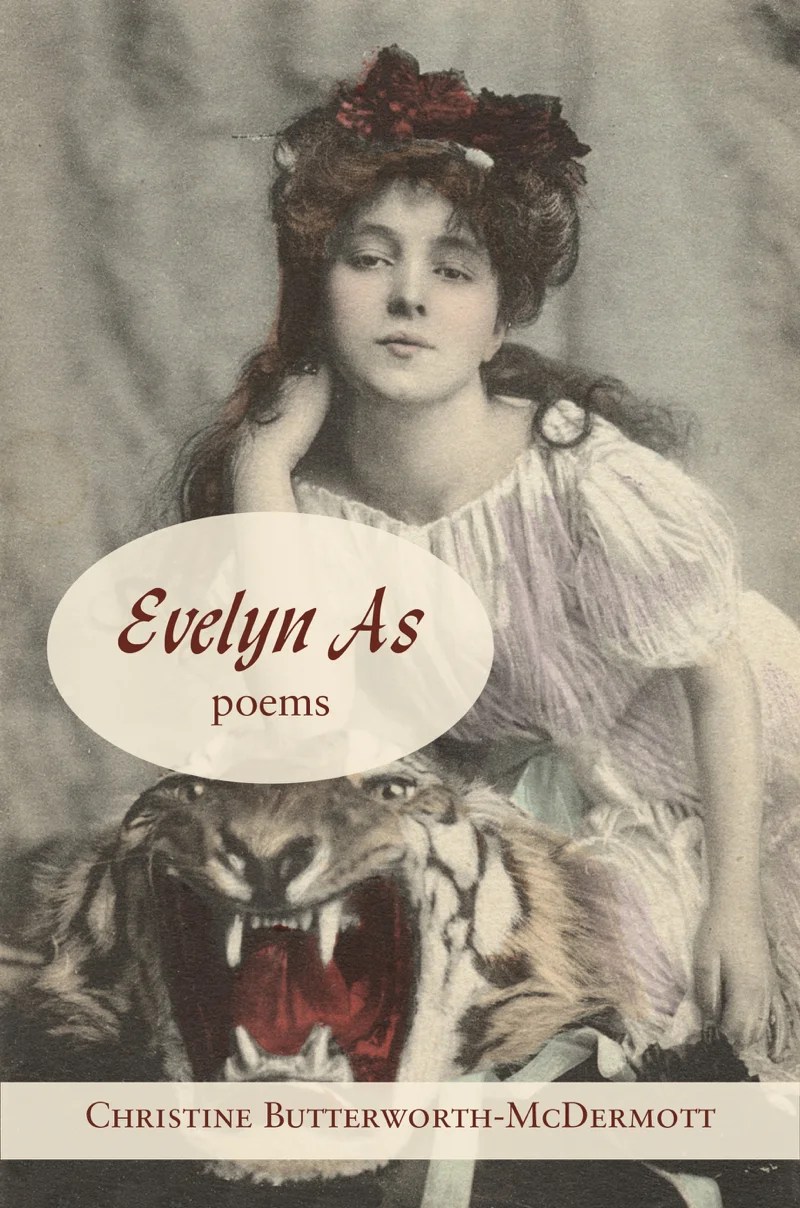
Matt Hart says “Evelyn As is a vivid, poetic account of the early life and career of late 19th and early 20th Century chorus girl, artists’ model, and actress Evelyn Nesbit. These dynamic, fraught, and textural poems provide a stunning and heartbreaking portrait of a life of stardom, violence, scandal, and survival, weaving together everything from the Persephone myth and Little Red Riding Hood to Rapunzel and Snow White—not to mention also gaze theory, the sometimes (wildly complicated) transformative power of art, and the roles we all play both willingly and un-. At its heart, Evelyn As is a compelling, gripping, and tragic blockbuster of a book, simultaneously cinematic, awe inspiring, and crushing.”
For further information about Evelyn Nesbit, please go HERE.
Reviews:
“Evelyn As. . .assembles snapshots of a life in order to serve as a source of real light for those who may desperately need it–those who may still be trapped in the artificial glow of what they are manipulated into believing they are worth.” Troy Varvel for Crab Orchard Review
“Evelyn As offers hope in its interrogation, in its willingness to confront these beasts and men and wolves, through the strength of women’s stories. It is both confession and apology, both love-letter and call to action, a book that will remind you of the importance of watching and listening to the vulnerable around you.” Joy Clark for Arkansas International
Woods & Water, Wolves & Women (2012):
“Terrific story telling by way of poetry. Not at all what I expected, and it knocked me for a loop. Familiar tales retold in a brilliant and unfamiliar way, getting right at the heart of what these stories were most likely about in the first place; not children’s yarns at all, but metaphorical little wonders sharp as diamonds, bright as stars. Christine McDermott is a marvelous talent, and I hope like hell someone is paying attention.” Joe R. Lansdale
In the tradition of all savvy tale spinners, Christine Butterworth-McDermott reshapes the characters from fairy tales for the contemporary landscape. Full of sassy tone, poignant new angles, wised-up attitudes, and probing psychology, her poems remind us that the faces of seduction, jealousy, curiosity, longing, and rue that appear in the tales are not unlike those we see in our own mirrors, year after year. Through both their familiarity and their strangeness, these poems discover new ways to relight the source material in order to delight the reader.” Jeanne Marie Beaumont
 Christine Butterworth-McDermott